roundup
The Best Desk Toys for Engineers Who Fidget While Thinking
The kinetic toys that let you think with your hands, tested for noise and durability on video calls and in deep work.
Devs At Home is a participant in the Amazon Services LLC Associates Program, an affiliate advertising program. We earn from qualifying purchases. This never affects what we recommend or what we say about it.
The best desk toys for engineers are kinetic sculptures that demonstrate physical principles while giving your hands something to do during compilation or while you work through a problem. A Newton's cradle or a Stirling engine sits in your peripheral vision and runs silently enough for video calls, which rules out most clickers and fidget cubes.
Key points
- Kinetic desk toys work because thinking is not purely mental — moving your hands while you work through a problem engages motor cortex pathways that support spatial reasoning.
- The Juvale Newtons Cradle Pendulum is silent when operating and demonstrates conservation of momentum, making it suitable for calls.
- The Sunnytech Low Temperature Stirling Engine Motor runs on a temperature differential as small as the warmth of your palm and operates continuously without batteries.
- Desktop punching bags and balance toys produce audible impact noise; reserve them for off-call hours or mute-by-default environments.
- Sand art and balance planes sit in peripheral vision without requiring interaction, functioning as ambient motion rather than active fidget tools.
- Gifting desk toys to a team works when the recipient can choose to display it or not — avoid anything that makes persistent noise or takes up more than six inches of desk depth.
Why engineers keep toys on desks: the thinking-with-hands argument, kept honest
You move your hands when you think. Most developers do. You spin a pen, you fold paper, you pick up whatever is nearby and turn it over while you trace through what a function is supposed to return. Motor activity during cognitive load is not procrastination; it is part of how spatial and procedural reasoning works. Your motor cortex and prefrontal cortex share pathways, and occupying one while using the other can reduce the subjective effort of the problem.
That explanation gets repeated in marketing copy for every fidget product sold, so approach the claim with skepticism. The effect is real but modest. A desk toy will not fix a poorly designed API or make a failing test pass. What it does do is give you something consistent to reach for when your hands want to move, which prevents you from picking up your phone or opening another tab. The toy is a redirect, not a cognitive enhancer.
Choose one that does not interrupt the person on a call with you. Anything that clicks, snaps or taps a desk surface creates transient peaks that trigger noise suppression or, worse, do not trigger it and play through clearly. Silent kinetic motion works. Clickers do not.
Kinetic toys: the ones that move and the physics they demonstrate
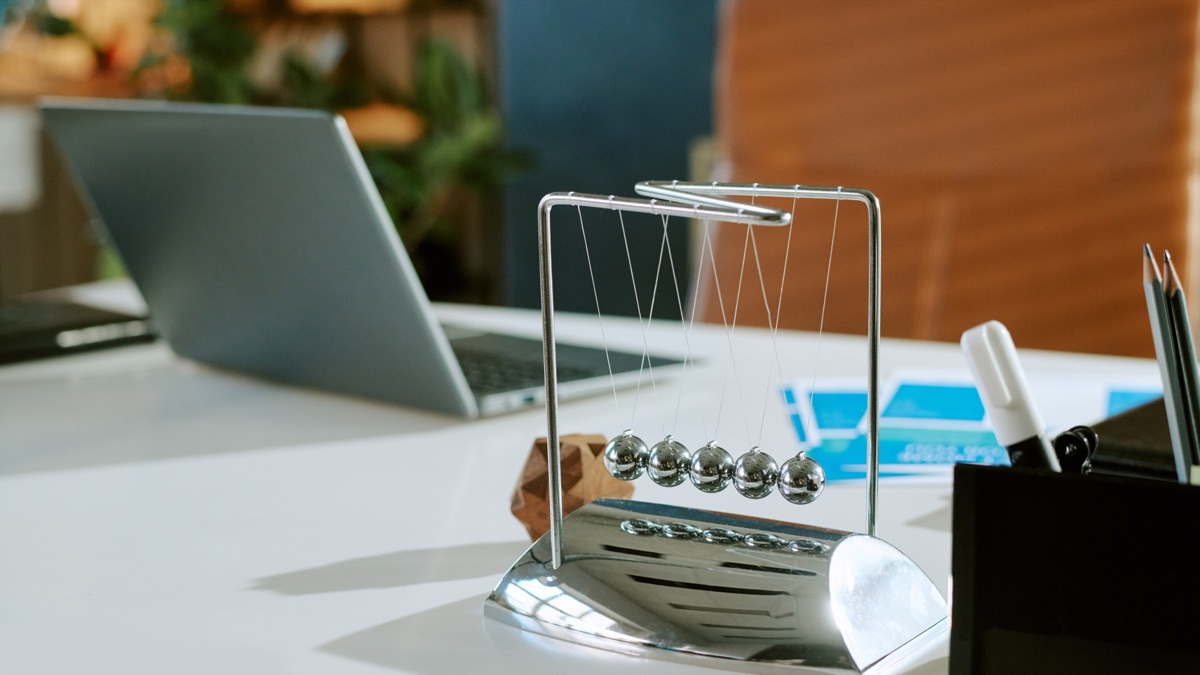
A Newton's cradle is five steel spheres suspended in a frame. Lift one end and release it. The impact transfers through the middle three without visible movement and ejects the sphere at the far end. It demonstrates conservation of momentum and elastic collision, and it produces a soft metallic tap when the spheres meet — audible in a quiet room but not harsh. The Juvale Newtons Cradle Pendulum is the version we stock. It sits in about six inches of desk depth and runs for fifteen or twenty seconds per pull.
The Sunnytech Low Temperature Stirling Engine Motor is the more interesting object. It is a heat engine that runs on a temperature differential: place it on a mug of coffee or in your palm and the flywheel begins to turn. The piston and displacer move air between a warm and cool chamber, driving continuous rotation without batteries or winding. It runs silently. The motion is hypnotic in peripheral vision, and it is a real engine demonstrating thermodynamic principles rather than a novelty. Expect it to run as long as the temperature difference persists, which is twenty or thirty minutes on a hot drink.
The balance plane and the kinetic weightlifter are simpler. The Sunnytech Steel Balance Plane sits on a curved base and rocks gently when touched, relying on centre of gravity to return to equilibrium. The Maydahui Balance Physics Toy Kinetic Weightlifter is a stylised figure that tips forward and back on a pivot, lifting a bar overhead as it rocks. Both are manual — you set them in motion and they settle. Neither makes noise. They function as objects to nudge occasionally rather than continuous motion pieces.
The GEKETY 3D Moving Sand Art Picture is not kinetic in the mechanical sense. It is a sealed frame with sand and liquid. Flip it and the sand falls through the liquid, forming temporary landscapes as air bubbles migrate upward. Each flip produces a different pattern. It takes a minute or two to settle. It is ambient rather than interactive: something that changes in the background while you work rather than something you manipulate actively.
The toys we stock, from conversation piece to stress outlet
The Stirling engine earns its place as a conversation piece. Non-engineers ask how it runs without batteries. Engineers want to know the displacement volume and operating temperature range, and then they search for the model number to buy their own. It is the one desk object that reliably starts a technical discussion rather than prompting polite disinterest.
The Newton's cradle is recognisable enough that it does not need explanation, which makes it less effective as a conversation starter but more effective as a fidget tool. You can pull it and release without thinking about it, and the repetitive motion and sound provide a predictable sensory loop. It works well for the minute or two between finishing one task and deciding what to do next.
The Tech Tools Stress Buster Desktop Punching Bag is a weighted base with a spring-mounted bag on top. Hit it and it wobbles back upright. It makes a dull thud on impact and the spring creaks slightly as it returns. This is not subtle. Use it when you are alone or when everyone on the call is muted by default. It functions as a physical outlet for frustration, which is occasionally what you need after a deployment fails or a build breaks in a way that should not be possible.
The sand art frame and the balance toys are the lowest-intervention options. They sit on a shelf or at the back of the desk and do not demand interaction. You flip the sand frame once a day or once a week. You nudge the balance plane when you walk past. They function as ambient objects rather than tools, which suits developers who want something in peripheral vision but do not want another thing to maintain or interact with actively.
| Product | Motion type | Sound level | Interaction frequency | Desk depth required |
|---|---|---|---|---|
| Juvale Newtons Cradle Pendulum | Continuous impact transfer | Soft metallic tap | Every few minutes | 6 inches |
| Sunnytech Steel Balance Plane | Manual rock and settle | Silent | Occasional nudge | 4 inches |
| Maydahui Balance Physics Toy Kinetic Weightlifter | Manual tip and return | Silent | Occasional nudge | 5 inches |
| Sunnytech Low Temperature Stirling Engine Motor | Continuous rotation via heat | Silent | Place and forget | 5 inches |
| GEKETY 3D Moving Sand Art Picture | Gravity-driven sand fall | Silent | One flip per session | 1 inch (vertical display) |
| Tech Tools Stress Buster Desktop Punching Bag | Impact and spring return | Thud and creak | Intermittent strikes | 6 inches |
The video-call test: which toys are silent and which are not
Most video conferencing software applies noise suppression to transient sounds, but the threshold varies. A single sharp tap might be filtered. Repeated tapping is not. Test this before you assume your mic is not picking it up.
The Stirling engine passes. The flywheel and piston move smoothly with no clicking or scraping. You can run it on a call without anyone noticing. The same is true for the balance plane and the weightlifter when you handle them gently. Set them down rather than dropping them and they are silent.
The Newton's cradle sits at the threshold. The metallic tap of the spheres is audible but not loud. It reads as background noise rather than a sharp interruption, and most noise suppression algorithms will not filter it entirely. If you are the only person speaking it will be noticeable. If someone else is talking it disappears into the noise floor.
The punching bag fails the test. The impact is a dull thud that triggers noise gates and interrupts speech. The spring creak is worse because it occupies a frequency range that noise suppression is not tuned to remove. Use this one off-call or accept that everyone will hear it.
The sand art frame is silent until you flip it, at which point the frame taps against the desk. The sand falling through liquid makes no sound. Flip it between meetings, not during them.
Desk toys as team gifts
Gifting desk toys to a team is straightforward when you accept that not everyone will display them. Some people prefer an empty desk. Others have a spouse or partner who will veto another object. Buy something small enough that it can be tucked into a drawer without guilt, and avoid anything that requires explanation or maintenance.
The Newton's cradle works as a team gift because it is immediately recognisable and self-explanatory. You do not need to demonstrate how it works. It is small enough to fit on a crowded desk or be stored without taking up significant space. It reads as a professional object rather than a novelty, which matters in some contexts.
The Stirling engine is a better gift for a small team where you know the recipients well enough to be confident they will appreciate it. It is more expensive and requires a brief explanation of how it operates, which makes it unsuitable for a broad distribution where some people will not engage with it. For the person who does engage, it is the more memorable object.
Avoid the punching bag as a team gift unless the team has explicitly joked about needing one. It carries an emotional connotation that not everyone will interpret the same way, and it occupies enough desk space that it becomes clutter if the recipient does not use it.
The sand frame and balance toys are safe middle-ground options. They are visually interesting without being demanding, and they can sit on a shelf if someone does not want them on the desk itself. Neither requires interaction to justify its presence.
Common questions
Do desk toys actually help you focus or are they just distracting?
They help by giving your hands a consistent target when you need to move them, which prevents you from reaching for your phone or opening a distracting tab. The effect is small and specific: they reduce low-level restlessness, not deep procrastination. If you are avoiding a hard problem, a desk toy will not fix that.
Which desk toys are silent enough for open-plan offices or video calls?
The Stirling engine, the balance plane, the weightlifter and the sand art frame are all silent in normal use. The Newton's cradle produces a soft metallic tap that is audible but not disruptive unless you are the only person speaking on a call. The punching bag is not suitable for calls or shared spaces.
What is the most durable desk toy if you are going to use it constantly?
The Newton's cradle is all steel and fishing line. The spheres and frame will outlast the strings, which you can replace. The Stirling engine has a piston seal that will eventually wear, but typical use is intermittent rather than continuous, so expect years before it fails. The balance toys are solid metal with no consumable parts.
Are kinetic desk toys appropriate for a professional workspace visible on video calls?
The Newton's cradle and the Stirling engine both read as scientific demonstration pieces rather than toys, which makes them appropriate for a professional background. The punching bag does not. The balance toys and sand frame are neutral enough that they do not signal anything specific, which is either an advantage or a missed opportunity depending on what you want your background to communicate.
Can you gift a desk toy to someone without knowing their workspace setup?
Yes, if you choose something small enough to be stored without guilt. The Newton's cradle, the balance plane and the weightlifter all fit in a desk drawer. The Stirling engine and the punching bag are larger and harder to store, so reserve those for situations where you know the recipient has space or will appreciate them enough to make space.
Do fidget toys work for everyone or is this a specific personality trait?
Most people move their hands during cognitive load, but not everyone experiences that movement as helpful. Some people find any object in peripheral vision distracting. Test the concept with something cheap or borrowed before you invest in an expensive kinetic sculpture.
How much desk space do these toys actually require?
The Newton's cradle, the Stirling engine and the punching bag each need about six inches of depth. The balance plane and weightlifter need four to five inches. The sand art frame can stand vertically at the back of a desk or on a shelf, so it takes up one inch of depth. Choose based on how much uncommitted space you have.
What do you do with a desk toy that turns out to be too loud or too distracting?
Move it to a shelf where it becomes a display piece rather than an interactive object, or give it to someone else who works in a louder environment. Do not force yourself to use something that does not fit your work style. The sunk cost is small enough that it is not worth the ongoing distraction.
What to buy and what to skip
Start with the Newton's cradle if you want something you will reach for multiple times a day. It is inexpensive enough that you can test whether kinetic desk toys suit your work style without a significant commitment. If you find yourself pulling it every time you pause to think, then consider upgrading to the Stirling engine, which is the more interesting object but also the more expensive one.
Buy the Stirling engine if you know you want a conversation piece and you have the desk space for it. It justifies its presence through novelty and demonstrates a real physical principle. Skip it if you want something purely functional or if your desk is already crowded.
The balance toys and the sand art frame are for people who want ambient motion rather than active interaction. They work well as secondary objects — something on a shelf in peripheral vision rather than something in arm's reach. Skip them if you need your hands occupied; they will not satisfy that impulse.
The punching bag is for off-call use only and only if you have space for it. It is effective for what it is, but it is loud and it occupies enough desk real estate that it becomes clutter quickly if you do not use it regularly. Most developers will get more use from a Newton's cradle.